Force pair
Attraction / Detraction
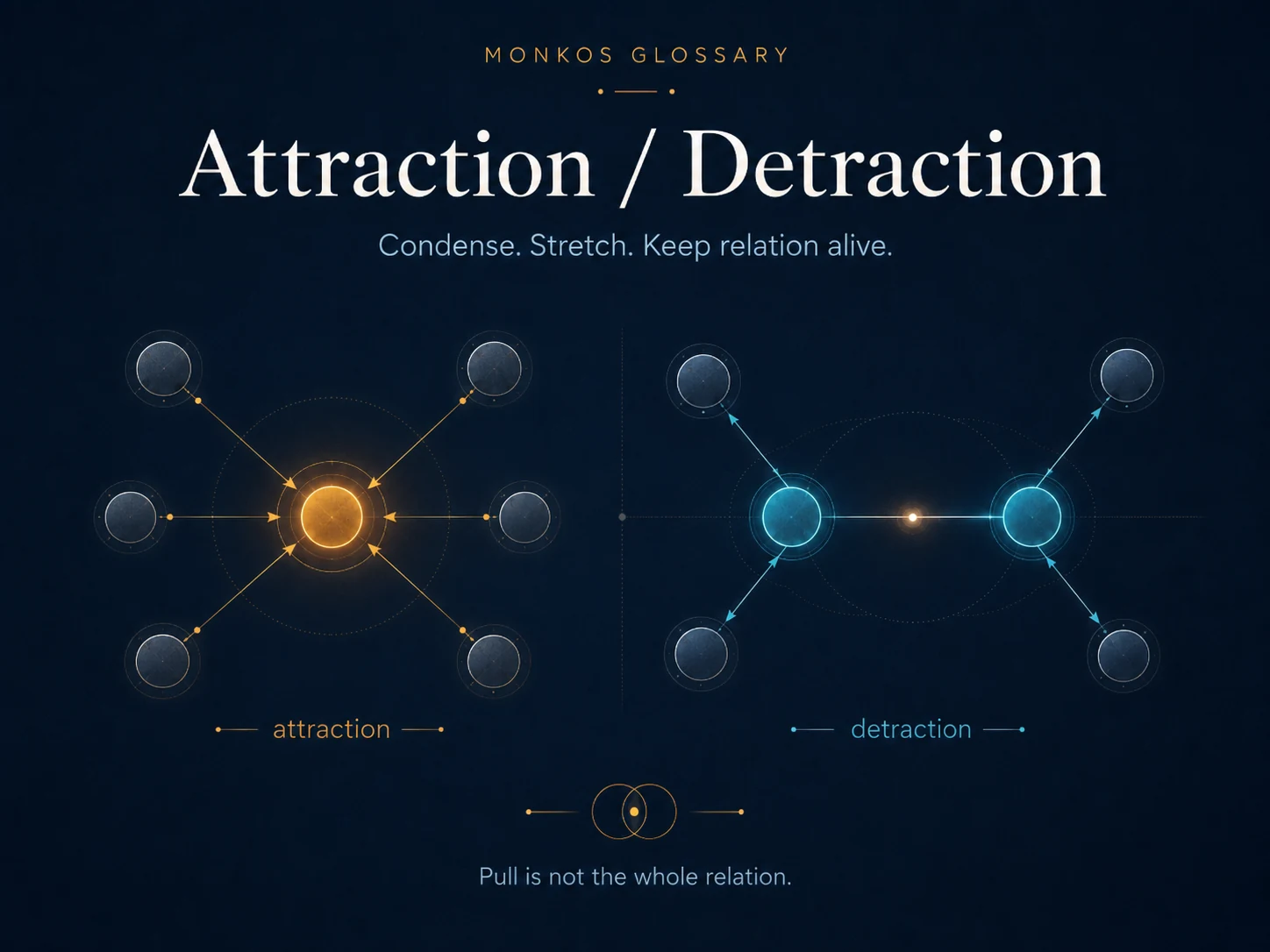
Concentration is not the only productive movement.
Semantic Gravity · Semonika
“Semantic gravity (SG) refers to the degree to which meaning relates to its context.”
Karl Maton · Making semantic waves · 2013, p. 11 · paper ↗
That definition measures context-dependence. Semonika places gravity inside a wider mechanics of meaning: attraction is one force, not the whole field.
Maton defines semantic gravity as a relative degree of context-dependence. Stronger semantic gravity means that meaning depends more on its context; weaker semantic gravity means that it depends less on that context.
A continuum from meanings that rely strongly on a particular context to meanings that rely on it less.
A separate continuum describing how much meaning is condensed within a practice, symbol, term, concept or expression.
Semantic gravity and semantic density are two variables, not a complete physics of meaning.
Semonika keeps the source definition visible, then asks what gravity alone cannot describe: stretching, complementary fit and relation itself.
Concentration is not the only productive movement.

A relation can work through difference, not only similarity.
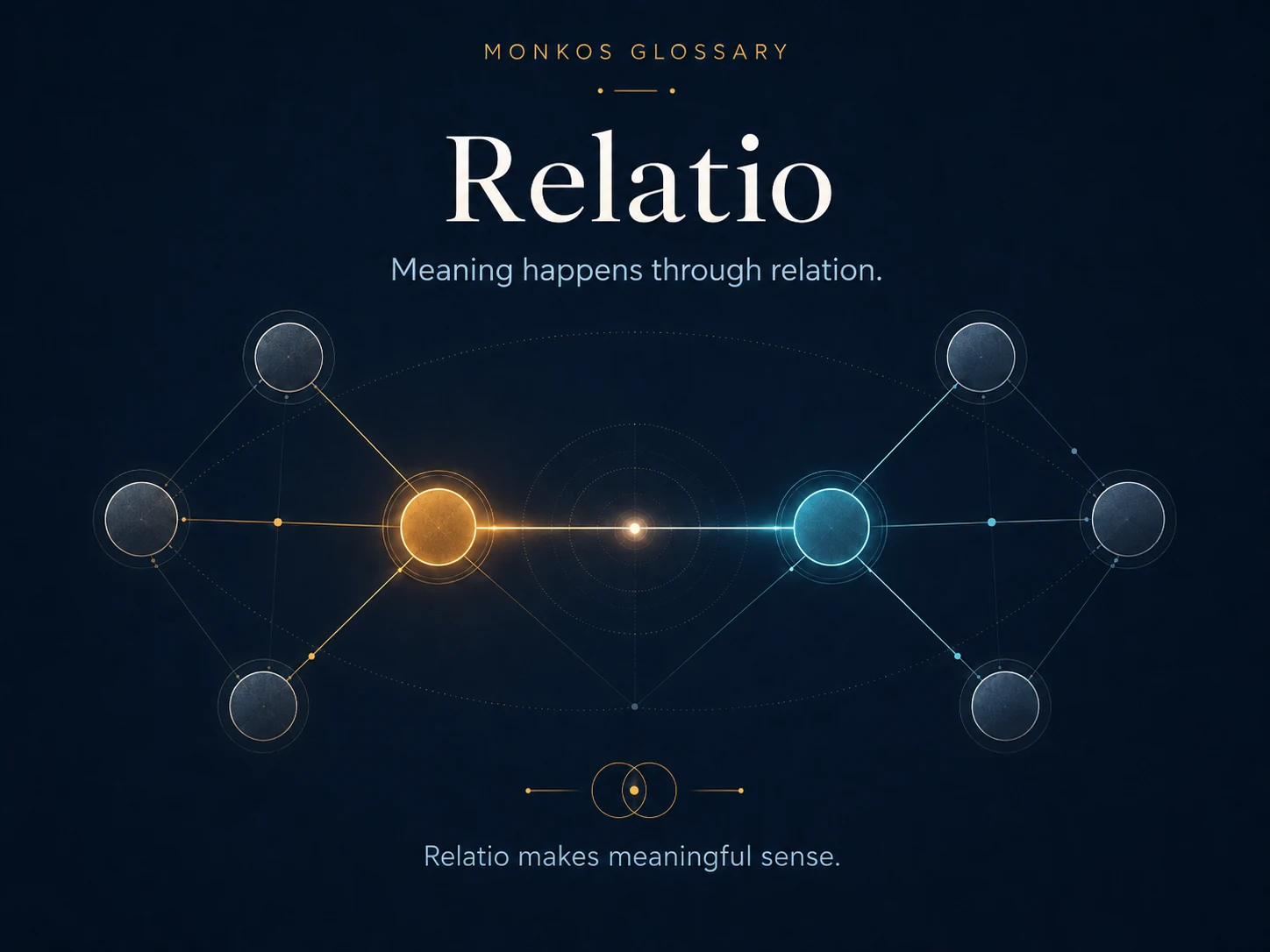
The operation exists only inside a relation.
Semonika treats physical relations, forces and transformations as a disciplined vocabulary for operations on meaning. The construction is systematic: a physical function receives the suffix -sema when it is mapped into the semonic field.
Resonance: amplification when an external signal meets the internal frequency of a system.
Compression: complexity held in a smaller form that must still be capable of being unpacked.
Refraction: meaning changes angle and speed as it passes into another social or media context.
Diffraction: meaning bends through a narrow opening in noise and passes an obstacle while retaining form.
Interference: signals can reinforce one another or cancel one another.
Doppler relation: the apparent frequency changes as a signal approaches or recedes in time.
Polarisation: a signal is filtered until it oscillates in one imposed plane.
Absorption: a signal enters the system but returns no reflection, decision or action.
Gravity only pulls. Semonika also compresses, stretches, refracts, diffracts, resonates, interferes, scatters and absorbs.
These terms become useful when they change an editorial decision. The point is not to decorate criticism with physics, but to name what the text is doing and where the transfer of meaning fails.
Context, rhythm, texture and time can enrich a passage. Once the load-bearing relation weakens or breaks, productive stretching becomes a floskula.
This is not automatic shortening. It is the removal of words, images or structures that continue after the semantic thread has lost its load.
A sentence may become shorter and stronger only if the reader can still unpack the distinctions it contains.
Does the meaning deform in a new medium, pass through noise while keeping its form, or meet a structure capable of amplifying it?
Hooke’s law describes an elastic restoring force: F = −kx. Semonika uses that relation as an operational mapping for attention displaced from its centre.
The equation and its physical meaning belong to mechanics and are attributed to Robert Hooke.
The mapping of that restoring relation to attention and cognitive centre belongs to Semonika, authored by Dragan Cvetanović.
In a semantic memory field of information, similar concepts gather through their relations. Search, documents, links and knowledge structures make that attraction observable on the internet. Semonika keeps the boundary visible: attraction is real as an operation, but it is never the only operation in the field.
The LCT definition is quoted from Karl Maton’s 2013 paper. The wider vocabulary of semonic forces and operations, their use in writing and the attention-restoring mapping are part of Semonika by Dragan Cvetanović.
Semantic gravity, semantic density and semantic waves.
Elastic restoring-force relation, F = −kx.
The -sema operations and their semonic use.
A semonic mapping does not claim that meaning is a newly proven physical force.